
Durable Flows
bloge-durable turns the BLOGE execution model into a runtime that can survive process restarts, support long-running waits, and scale into more demanding production topologies.
What durability adds
BLOGE's durable module persists execution identity and runtime state through focused stores.
| Store | Responsibility |
|---|---|
ExecutionStore | Execution lifecycle, status transitions, leases, and business-key lookup |
ExecutionCheckpointStore | Node outputs, suspend context, loop snapshots, and session checkpoints |
WaitStore | Pending waits and timeout metadata |
WorkItemStore | Retry, timer, event, and task work dispatch |
LeaseStore | Generic fenced lease management |
GraphRegistryStore | Persisted graph definitions for cold recovery |
RoutingStore | Shard and tenant route bindings |
TaskInboxStore | Human task assignment and inbox data |
EventMatcherStore | Runtime event correlation state |
Additional services include ArchiveService for data lifecycle management and DurableControlPlaneService for governance and operational queries.
Wiring durable stores into the engine
DurableStoreFactory.RuntimeStores stores = DurableStoreFactory
    .builder(primaryDataSource, replicaDataSource)
    .migrateSchema()
    .runtimeStores();

GraphEngine engine = GraphEngine.builder()
    .registry(registry)
    .executionStore(stores.executionStore())
    .executionCheckpointStore(stores.executionCheckpointStore())
    .waitStore(stores.waitStore())
    .workItemStore(stores.workItemStore())
    .graphRegistryStore(stores.graphRegistryStore())
    .routingStore(stores.routingStore())
    .build();
This keeps the same programming model while adding persistence-backed recovery.
In-memory path for local development
Durable flows do not require a database during early development. The module also provides InMemory*Store implementations for tests, demos, and local scenarios.
Local or H2-backed evidence demonstrates only that selected durable actions and declared business facts hold in that harness. It does not establish compatibility with a production database, failover topology, network, or operations environment.
Recovery model
Durable BLOGE flows can recover from:
- process restarts
- timer-based waits
- external event resumes
- session and round checkpoints
- persisted graph lookup for cold-start rebuilds
The key idea is that long-running state moves into durable runtime stores rather than into ad hoc application-side tables and compensating code.
Routing, shards, and multi-tenant setups
Durable routing is built around execution identity and route keys. Available router strategies include:
SingleDataSourceRouterHashShardRouterTenantShardRouter
Tenant isolation strategies include shared tables, separate schemas, and separate databases. Read/write routing uses ScopedValue scopes so nested operations remain consistent across primary and replica data sources.
Archive and governance
Durable systems need more than checkpoint persistence. bloge-durable also includes:
- hot-to-archive lifecycle policies (
MOVE_TO_ARCHIVE,SOFT_DELETE,DELETE) - archive job tracking
- transition logs
- dead-letter inspection
- control-plane queries for executions, tasks, and work items
This is the operational layer that helps teams run orchestration safely over time instead of only getting the first execution to succeed.
Session and task support
Durable support also underpins:
- session checkpoint persistence
- task inbox and human task flows
- event correlation adapters
- resumable wait/await patterns
These are especially important for approval workflows and conversational flows that extend across multiple user interactions.
Observability integration
When bloge-metrics-otel is present, durable stores can emit metrics such as:
bloge.checkpoint.write.durationbloge.checkpoint.recovery.durationbloge.workitem.queue.depthbloge.lease.renewalbloge.lease.renewal.duration
That complements the graph- and node-level metrics emitted by the core engine.
Supported databases and migrations
Durable migrations currently target:
- H2
- PostgreSQL
- MySQL
Flyway migrations provision runtime, session, archive, and governance tables through versioned migration sets.
When to adopt durability
Add bloge-durable when your flow needs one or more of the following:
- resume after restart
- wait on timers or external signals
- user-task or approval inboxes
- durable routing and sharding
- operational archive and governance controls
If all your graphs are short-lived and in-memory execution is enough, the core runtime may be sufficient.
Verify a retained durable path
The Preview bloge-verification module can execute a finite retained-session chain using EXECUTE, SIGNAL, ADVANCE_TIME, and guarded RESUME actions.
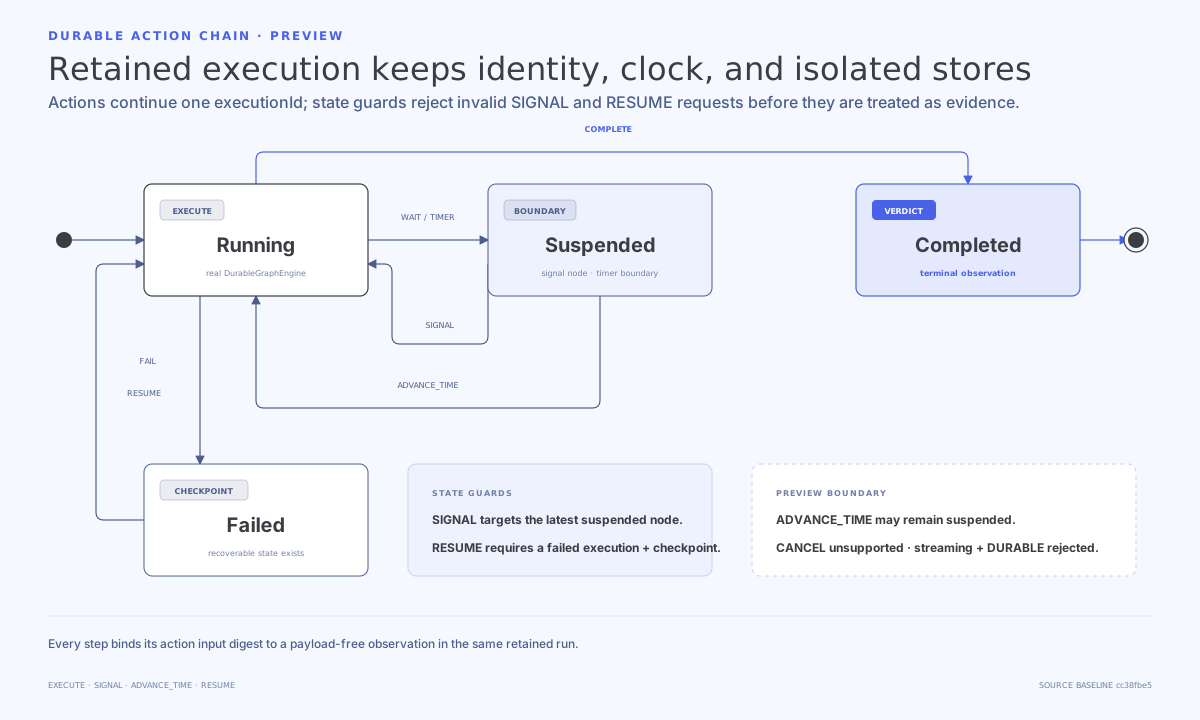
CANCEL and streaming durable verification are not supported in this 0.9.8-RC1 slice. See the durable verification guide before interpreting local evidence as a team gate.
Next steps
- Add framework integration in Spring Boot
- Instrument runtime behavior in Observability
- Explore long-running examples in Example Catalog
- Verify retained-session behavior in BLOGE Verify